Talk to me through whatsapp!

2011 / 2017


Carried out in Madrid between 2011 and 2017.
This was the first of many tattoos I made for Fede.
Everything has started in 2010when asked me to cover a tattoo for himthe only one I had at the time.
Fede had on the outside of his right arm the figure of a wolf. in black and gray. It wasn't a poorly done tattoo, which is the case with most cover ups, it just started to look too small and simple for that part of the body. I wanted something bigger and that time with colors.
I came with the idea of a tiger. and I said yes. I love tigers, but other than that, the wolf tattoo It had hardly any lines and its predominant color was gray, could be perfectly disguised with the image of a tiger. with its beautiful striped fur.
We started tattooing in January 2011I drew the outer part of the arm, from shoulder to elbow, to make the cover up. For this, I prepared the drawing of a fierce tiger wrapped in sakura and kaze. One of the classic Japanese representations, climbing a rock on his back, with his head turned, looking for anyone who observes him.


"Tigers do not form herds and are solitary predators. They do not depend on any other animal and fear nothing. A tiger illuminated by moonlight makes a perfect figure. It is capable of traveling a thousand miles in one night, approaching silently and striking like the wind; there is no other creature as brave as the tiger, it does not fear dragons and attacks them without hesitation. Since ancient times, when two brave warriors engage in combat, they are described as 'the tiger and the dragon'. The tiger must be the mightiest of animals."
Horihide from Gifu / Famous Japanese tattoo artist

After some time, Fede came back to me from that time to do something related to Buddhism.philosophy that he has followed since he was a child. Then I made the biceps area a manji pattern forming a beautiful sayagata three-dimensional, in red, orange and yellow.
Although unhappily in the West it is associated with Nazism, the swastika is originally Hindu and has existed for seven thousand years. and is represented in the art, iconography and design of various civilizations throughout history.

In 2016 we finished the Japanese manga shichibu. completing what was missing from the forearm. To do this, this martial arts lover asked me for a drum with the tomoe symbol.


To complete the composition of this arm of harmonious and balanced formnothing like following the basics of Japanese tattooing.
One of the foundations of the horimono is to apply the traditional black and gray background (gakubori). These pigments help to highlight the colors of the main elements because of the strength of the contrast they cause. Other pigments or the skin tone itself as a background do not cause the same effect because they are not as dark.
These backgrounds usually contain elements of nature: generally water and air.combined with each other or separately. In addition, the elements of nature bring with them all that they represent. Visually they may be in the background, but as a symbol they are often more important than the central figures of the composition.
For Fede's tattoo we chose the kaze, referring to the air element using swirls, clouds and wind gusts.

In addition to enhancing the colors, this type of background also gives a lot of movement to the drawing, especially if it is combined with sakura.. Those small flowers that symbolize the transience of our existence. are repeated all over the arm leaving the structure of the drawing more uniformThe same colors are distributed along the length of the sleeve.
Another of the fundamentals of Japanese tattooing is to achieve a good aesthetic result by means of the repetition of elements. For example, a chrysanthemum arm, in principle, will have only chrysanthemums and a black background. Although the flowers may vary in color, size and shape, they will all be chrysanthemums. The same concept is applied in design and visual arts.The company has been present all over the world since ancient times.
In the case of the irezumi by Fede, we started with a tiger, sakura and kaze. If it were up to me, I would have continued the manga with another tiger and more sakura and kaze, following the basics of traditional Japanese tattooing, but tattoos are not always designed solely by the tattoo artist.
So, with Fede's arm, we already had three main motifs: the tiger, the manji and the tomoe, too many for a Japanese manga. And we were left with a small space on the inside of the forearm where we needed one more element.
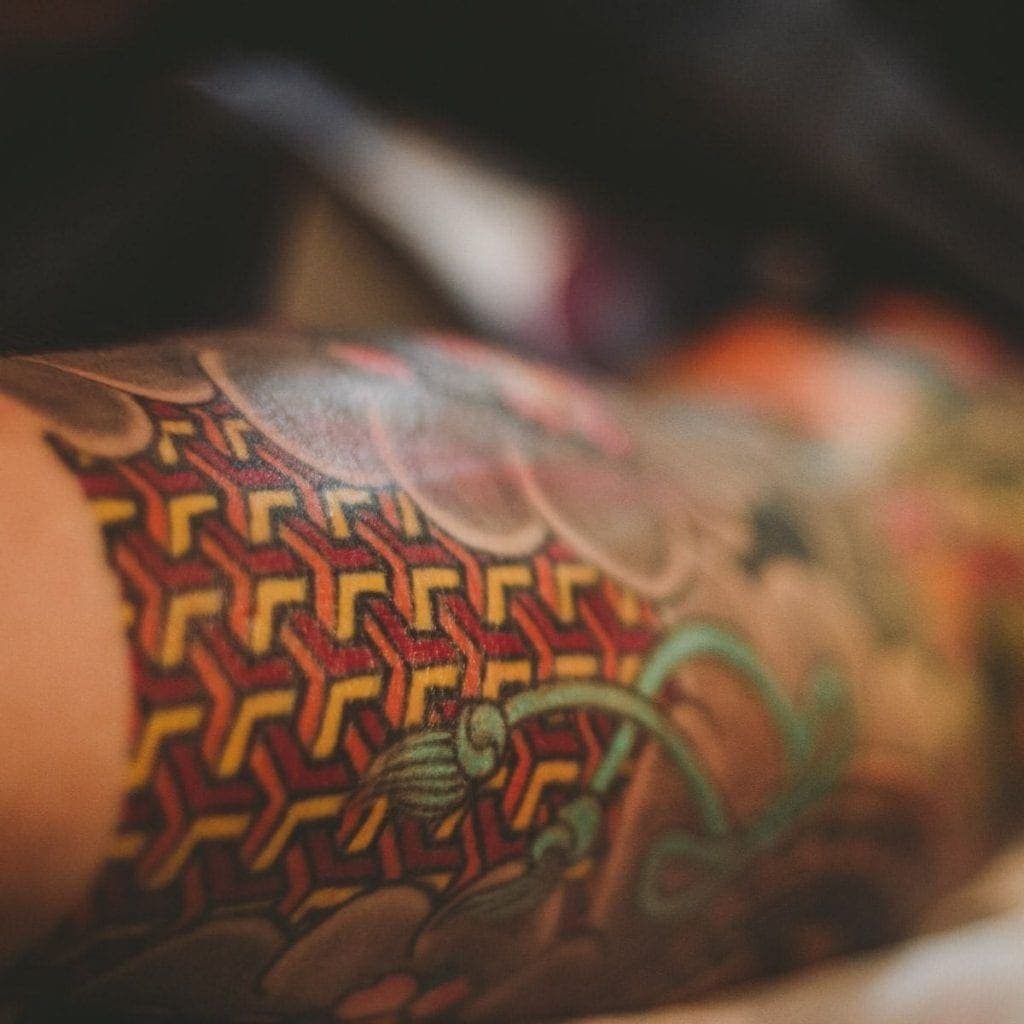
My idea was to repeat one of the elementsand the most appropriate was something similar to the one seen on the inside of the arm: the sayagata. Fede didn't want the same pattern in the forearm area, so I found him another one, the precious kawari bishamon kikko, famous in Japan and widely used in samurai armor. It has a related symbology with everything on the arm. We used the same colors as the sayagata to match, and in the end I loved it.
If you want to know a little more about this tattoo and see a video, go to the blog by clicking here.