Talk to me through whatsapp!


This film contains four separate and distinct stories.


Talk about the film, it helps a lot to better understand the film. Masaki Kobayashi
This credits sequence (interspersed with the names of the cast and crew typed on quality paper, as if it were a book) serves multiple functions: It marks director Masaki Kobayashi's transition from the monochrome of his earlier work to a striking use of Eastmancolor's full palette; its mix of different, clashing colors foreshadows the film's merging of the material and spiritual worlds; and, above all, it signals the film's literary origins, having been adapted by screenwriter Yoko Mizuki from a collection of short stories by Lafcadio Hearn.
The ghost stories (and entomological essays) in "Kwaidan: Stories and Studies of Strange Things" represented part of Hearn's dispatches from Meiji-era Japan, where the Greek-born, British-raised, American-based writer settled in 1890, marrying a local woman, fathering four children and becoming a naturalized citizen (and Buddhist) before his death in 1904. Hearn had long been exploring the cultural geography of wherever he was posted, and the last chapter of his life in Japan coincided with the emergence of Western interest in the aesthetics of this remote nation.
Hearn helped, as it were, to put Japan on the map, and by adapting four of Hearn's stories, Kobayashi too, elated by the success of Harakiri at Cannes (where it won the Special Jury Prize in 1963), hoped to attract more Western attention to his domestic cinema, with Hearn serving as a medium between these two worlds.
However, shot mostly on sound stages and with very mannered sets, it is a film of rare, hermetic beauty, replete with ethereal images and wandering ideas that haunt the mind.
If all of Kwaidan's stories are set in the past, the first of them immediately sours and complicates any straightforward notion of nostalgia, as the past turns out to be an irreparable place of decay, death and horror.

Thus, over the years, he keeps returning - in his mind, in his dreams and perhaps even in reality - only to be confronted by the ruins of his former home and the monstrousness of his own reflection.
Encountering the ghost of his first wife, now a living presence of devotion, now a skeleton reduced to the "same shiny black hair" he had once so adored, he flees through a shifting space, part well-maintained mansion, part dilapidated ruin, where he, rather than his late wife, is the real monstrous specter, trapped in a twilight zone between cherished past and desolate present.
This entire episode was cut from the version of Kwaidan that was screened in the United States, in an attempt to shorten the length of the film. But it would be a shame to miss this story of love and death, with its beautiful snowy sets and vivid backdrops painted with giant eyes, and later giant red lips, to signify that Minokichi is always being watched by something supernatural that has both an erotic and protective interest in his treatment of him.

As befits a tragic romance, this episode has a truly bittersweet ending, as the very intimacy of Minokichi's relationship with his beloved is, paradoxically, what will drive her away from him.
We see a re-enactment of the naval encounter, with occasional cuts to paintings of it, while we hear an account of the battle sung to the accompaniment of a lute-like biwa. In other words, from the outset we are made aware that this event, though fixed in history, is also a mediated affair, coming with multiple representations in art (painting, music, epic poem) that, like a tomb, maintain its memory.
Seven hundred years after the battle, a blind novice monk named Hoichi (Katsuo Nakamura), famous for his "uncanny ability to recite battle," is summoned from the local temple to offer a nightly performance to a Lord and his entourage. As this performer, blind as the epic rhapsode Homer, recites to his biwa, he fails to realize that he is not actually in a Lord's great hall, but in the clifftop cemetery, commemorating the last exploits of the Heike clan to their gathered ghosts. Once the head priest (Takashi Shimura) discovers what happens each night, he intervenes to save Hoichi, with painful consequences for the young monk, though it's not entirely clear that Hoichi is actually in danger or in need of saving.
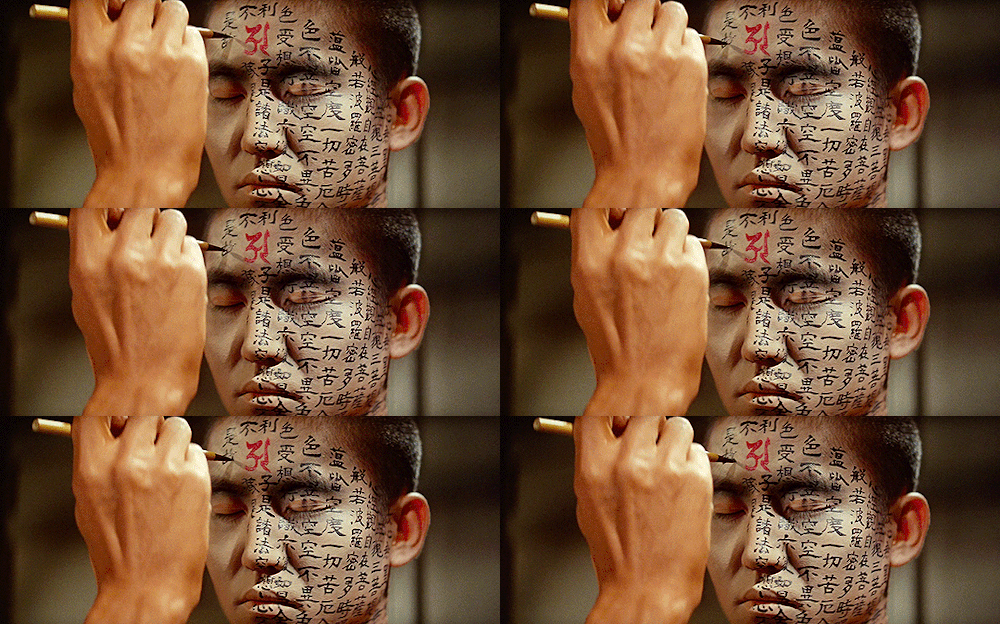
Hoichi the Earless" is a hauntingly beautiful meditation on the power of art to evoke the past and bring it to life, and serves as a mise en abyme for Kobayashi's own period film, which resurrects and recreates not only stories from two different Japanese historical eras, but also Lafcadio Hearn's text from 60 years ago who, having lost one eye in childhood and suffering from myopia in the other, was almost as blind as Hoichi. Shut out by the sensory deprivation of this world, Hoichi serves as a medium for the next. And if, in the end, the temple priests can no longer be sure whether the now-famous bard's audience is "fake or real," his sweet, sad song goes on.
It begins in 1900 (when the real Hearn was writing his own Kwaidan stories) with an unnamed author (played by Osamu Takizawa) at his desk inking a story that the narrator (also voiced by Takizawa) warns will be "curiously unfinished," and jumps to the story proper, set 220 years earlier, in which landowner Kannai (Kan'emon Nakamura) sees the face of a smiling stranger (Noboru Nakaya) impossibly reflected in his teacup.
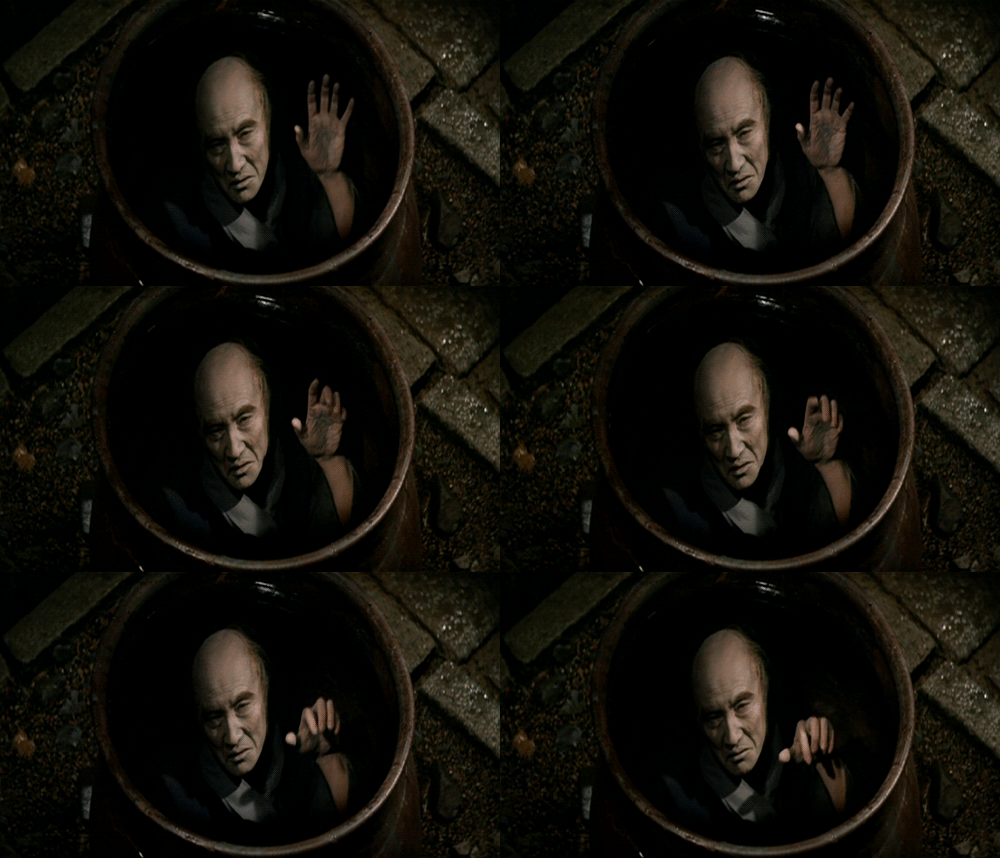
After unwisely swallowing the tea, the squire becomes embroiled in a supernatural dispute with the ghost man and his three equally ghostly servants. As promised, the story does not come to a resolution. Instead, we return to the author's house in 1900, though the author himself is mysteriously absent, with his work interrupted midway through. And so, this second unresolved story (about the author) reveals to us, in its final image, how nothing "swallows a soul" as well as an involving ghost story. We are left to examine the tea leaves and complete our own ending.
All four stories feature a score by the great Toru Takemitsuwhose concrète electroacoustic music constantly confuses the viewer as to where the soundtrack ends and the intradiegetic sound effects begin. The artificial sets of Dai Arakawa also constantly change their appearance (especially in The Black Hair and in Hoichi, the earless one), and only the montage of Hisasho Sagara maintains a semblance of continuity. The result is a work at once delicate and delirious, as cinematographer Hisashi Sagara's majestic framing can barely contain the more irrational narrative elements that intrude so insistently. It is also the most unnerving and awe-inspiring cinema.