Talk to me through whatsapp!


Sakura is the Japanese word for cherry blossoms and the Japanese cherry tree. The cherry blossom is considered the national flower of Japan and is one of the best known symbols of this culture.
In Japanese tattooing, the sakura receives the same prominence as in other cultural spheres of Japan. It is one of the four most frequently tattooed flowers in this style and undoubtedly one of the most frequent motifs in the Horimono.
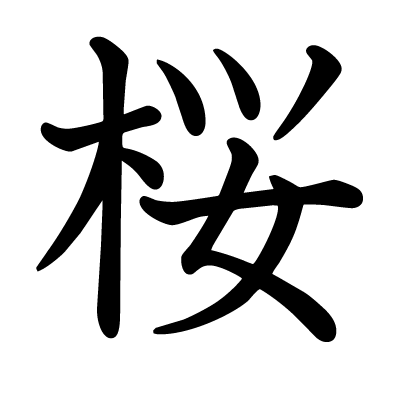
There are several theories as to the etymology of the word sakura.
One of the theories says that its branches were used to make omens about the rice harvest and that '.sa' alludes to the spirit of the grain and 'kura' to the divine altar.
Another hypothesis is that the word is an abbreviation of the name Konohana-sakuya-himea deity related to cherry trees.
There is also a third theory that believes that the word is derived from sakiurawhich means splendorous flowering.
The cherry trees have become very popular in the period of Heian (794-1185) thanks to a series of feudal lords. Due to the great beauty of these trees, these The government has started to plant them in attractive locations, thus spreading the habit of going to see them among the population.
In 1822 they began to be exported to Europe for the same reason: cherry trees beautify the surroundings and captivate people.
In Japan, every year cherry blossom marks the beginning of spring and the time of rice cultivation.
These events are celebrated with large festivals, some related to the planting of rice and the fertility of the land. The most popular of these celebrations is the national festival of the hanami to take a close look at the blossoms of the esteemed cherry trees.
Episode 92 of Shin Chan with the title "It's the Cherry Blossom Festival again". It premiered in Japan on April 11, 1994. The first scene shows people celebrating hanami among the cherry trees. In the other there is a group of men who are also at the party with their backs tattooed: each one has part of a large cherry tree on his skin and together they form a complete figure.
Hanami literally means "to see flowers". This is the name of the Japanese tradition of observing the beauty of flowers, but the word is usually associated with the period when the cherry blossoms bloom and the Japanese flock to parks and gardens to gaze at the flowers. sakura.
Mount Yoshino in Nara is worth mentioning as one of the most frequented places to witness the cherry blossom in April. It is said that the first cherry trees were planted more than thirteen centuries ago and there are now more than 30,000 trees.
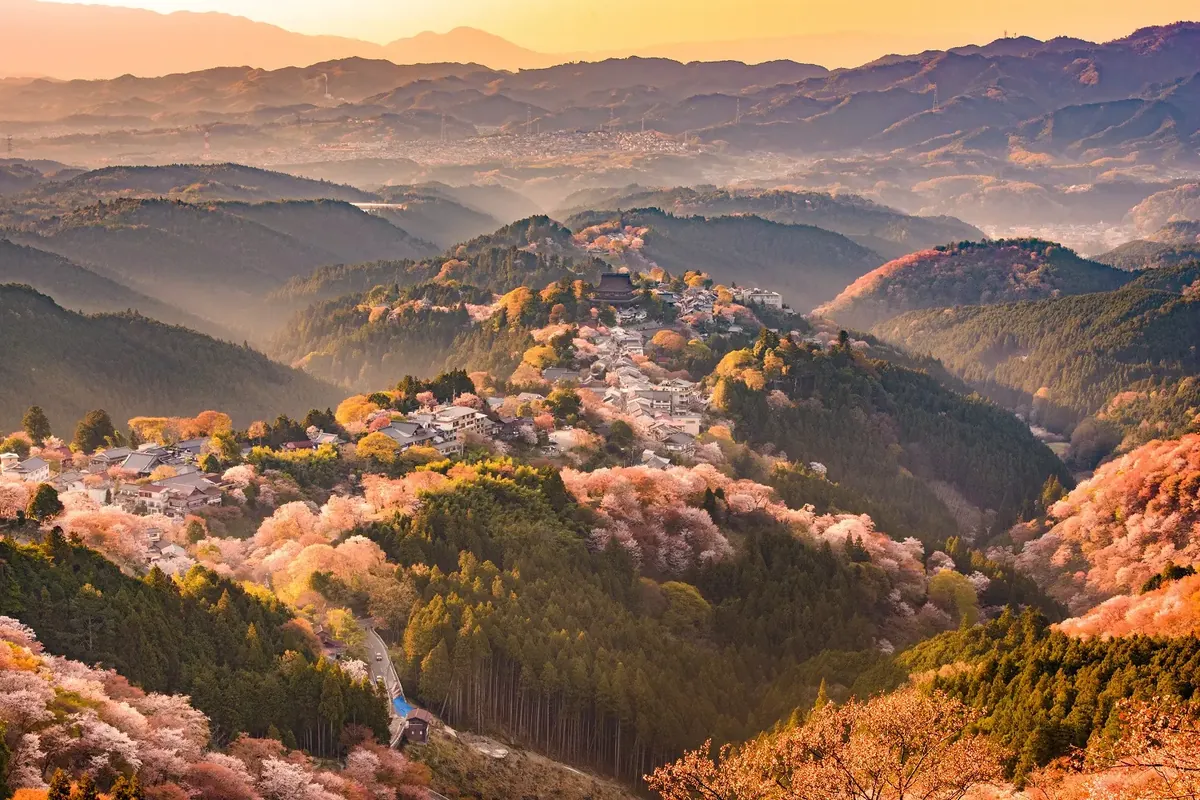
After these joyous festivities, the cherry blossoms begin to wilt. For Japanese students, this moment marks the end of the spring break and the beginning of the start of the new academic year that occurs in the second week of April. It is time to start a new cycle with renewed energy.
Japanese cherry is a species native to Japan. and belongs to the family of rosaceae of the genus Prunus.
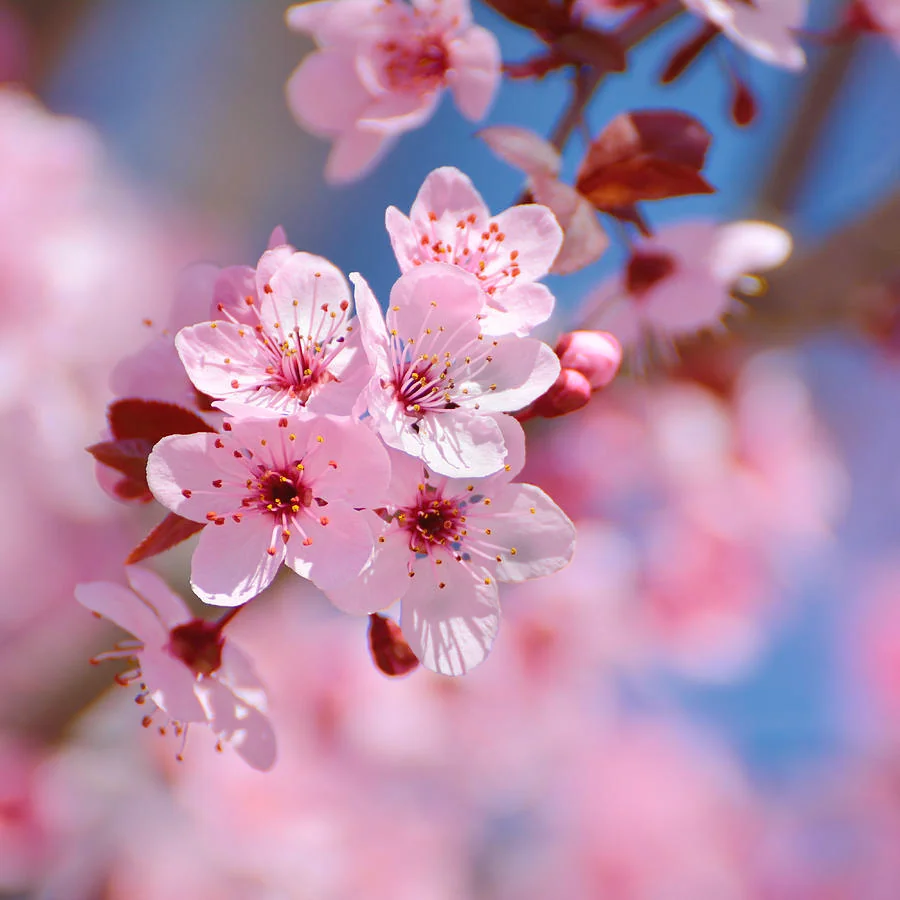

Its flowering heralds the beginning of spring in mid-March or early April, depending on the year and the area of the country in question. This moment is quite a spectacle and the Japanese people follow it all through the media and by going to parks and forests to witness it first hand.
There, cherry trees are prized for their tiny, delicate five-petaled blossoms that for only a few weeks a year decorate the entire Japanese territory with their pink and white tones.
The fruits, when present, are not recommended for human consumption. However, while the sakura food is prepared with its flowers, which are edible in small doses.
By clicking on the thumbnail where you read "Sakura food & Drink" you will be able to access an article that tells more about the delicacies that accompany the hanami and the Japanese spring.
If you are in Spain, there is no need to go all the way to Japan to witness the spectacle of the sakura in the spring.
The Jerte Valley in the Extremadura area also celebrates cherry blossom in style and justly on the same dates as in Japanas the seasons coincide.
This is a little souvenir of a trip to the Jerte Valley in spring to see the cherry blossoms in bloom. The video is from @fidelfoto
There are more than a million and a half cherry trees throughout the valley and you can walk through the small villages enjoying the scenery and local cuisine, among other things.
And in Spain, after the flowers wither come the fruits to the delight of all.
Between May and July we can enjoy this great gift from Mother Nature that are the Spanish cherries and picotas. It may seem like an exaggeration to describe them this way, but this is the best way I can find to define them!
The cherry blossom has a vast symbolism in Japan that varies according to cultural background. These meanings are related to each other in such a way that one reinforces the other. Or so it seems to me! In the following paragraphs I will explain my reasoning.
A national symbol is that which represents a nation in its different cultural aspects and throughout its history.
Japan has several national emblems that are elements of nature, probably because of the strong presence of its indigenous religion, the Shinto. There are official badges that are plants, animals, stones and mountains.
The Shinto is the primitive religion originating in Japan. In this creed, the entire natural world is endowed with life, soul or consciousness of its own and is therefore considered sacred. In other words, mountains, rocks, water, wind and flowers are divinities.
The Kojiki and the other oldest writings on the history of Japan cite a divinity known as Kono Hana, o Konohana-sakuya-hime. The name of this goddess, described as a beautiful young woman, refers to the word flower (hana in Japanese). And it is said that the term sakuya may have given rise to the word sakuraas I have previously commented in this same post.
It is reported in kojiki that all who descend from this goddess shall be mortal. Y Carlos Rubiowhen he tells the story of Kono Hana in his book Myths of JapanThe author makes reference to the cherry blossom and its relationship with this divinity. He also comments the following about the symbolism of the cherry blossom:
It is common knowledge that Buddhist philosophy does not worship any gods. However, in Japan the Buddhism merges with the Shinto and assumes a number of animistic characteristics.
These animistic properties of the Buddhism Japanese values in no way clash with the essential values of the Buddhism originated in India.
Many Japanese people incorporate Buddhist and Shinto values into their daily lives, and share a great devotion to nature.
Among these values is the daishizen. It is a practice that consists of contemplating natural environments and meditating, thus achieving a spiritual transformation and a more intense and real connection with nature.
When contemplating nature, many find in the cherry blossom one of the great Buddhist values: the transience of life. Nothing remains, everything passes.
Searching for expression monkey not aware in a Japanese language dictionary or on the Internet you will find the following definitions for this concept: appreciation of nature or ephemeral beauty, sadness or sadness, or the pathos of things, shock or empathy towards something.
It is a Nipponese term widely used in literature and philosophy to refer to the awareness of impermanence or the brevity of things. It is really difficult to assimilate this idea for anyone who is not Japanese and is not familiar with this expression.
What better than a practical example to understand something difficult to explain? Well, in all the sources that comment on this concept, they use as a practical example of monkey not aware the feeling aroused by the act of contemplating cherry blossoms. For this reason I did not want to fail to quote this expression here.
Visualize this situation: you stop for a moment to look at a cherry tree in bloom and appreciate the flowers in different stages. Some newborns have not yet finished opening. Many are in full bloom, in their prime. Others are already wilting and losing their petals. In a few seconds you are invaded by mental images related to childhood, youth and old age. One day after the other and the eternal cycle of the seasons, the inevitable passing of time. The absolute certainty that we are all like these cherry blossoms in the face of nature. This sensation is a form of monkey not aware.
After thinking about the idea, this concept no longer seems so strange.
I would say that in the world of tattoos we find many elements that want to convey similar ideas, or at least induce this type of reflection. The phrase "Everything happens" is usually tattooed on the fingers of the hand, to gain due prominence. Another very popular saying in Spanish is "you only live once". There are very powerful images of skulls that invite to deliberate on life and death. Hourglasses are always a reminder of how fast the hours go by.
And if we go to Japanese tattooing, we have cherry blossoms, sometimes as a main element on the arms of the tattooed, and sometimes as a secondary element all over the body. They are there to decorate and sometimes to meditate on, ephemeral and beautiful.
If you like martial arts, Japanese war movies, the anime or the sleeveYou have probably already seen scenes or images that relate the samurai and cherry blossoms. There are numerous tales that relate the identification of these warriors with the cherry blossom. sakura.
All of these writings and the large audiovisual production that relates the samurai caste and the sakura refer to the values conveyed by the bushido. Actually a set of martial rules already existed in Feudal Japan (c. 1185-1603) but it was not written down as we know it today.
The famous military code of conduct we have access to today was released at the end of the 19th century and brings a romantic and idealized vision of these warriors. Even so, the bushido He upholds principles of honor and loyalty that have since inspired not only military and martial arts practitioners, but people all over the world who find in him the motivation to move forward with their lives.
Again we can find the cherry blossom as a symbol of the transience of life.
The concept bushido and its relation to the sakura are part of the psyche and history of the Japanese people. And it's not all flowers when it comes to the military class.
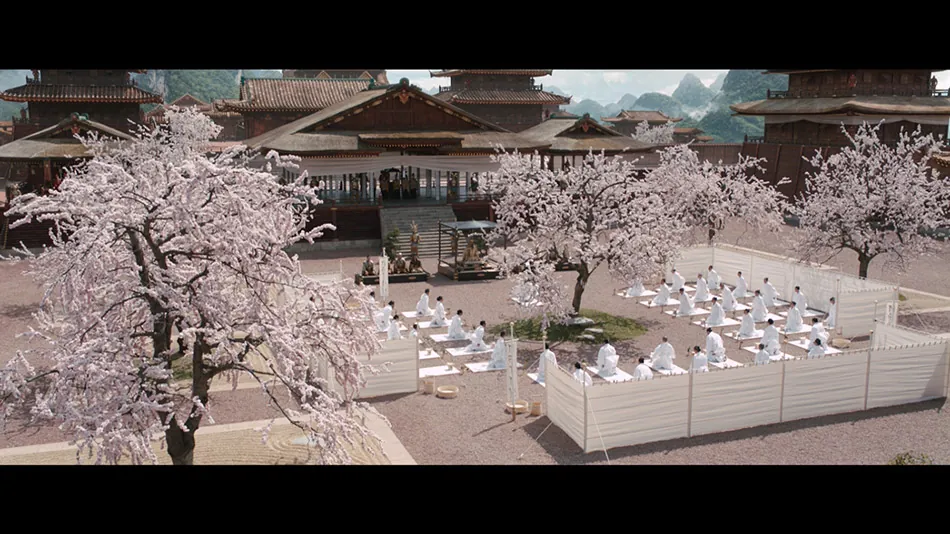
It should be recalled that in World War II, the Japanese have invoked the sakura as a symbol of a short life on more than one occasion.
To cite a couple of examples, the cherry blossom decorated the Yokosuka MXY-7The single-use rocket planes flown by the suicide pilots known as kamikaze. The sakura also made history by naming a well-known Japanese military plan: 'operation cherry blossoms by night', a germ warfare that caused the death of more than 580,000 people.

Previously in this post I have told that the cherry blossom marks the beginning of spring in Japan, the time of rice cultivation and that everything is celebrated in a big way.
I have also commented on the animist beliefs of the Japanese people and their beautiful relationship with nature. This being so, the seasons of the year also have great symbolic value and a place in the imaginary of this nation..
What does spring say to you?
It is not only in Japanese culture that the beginning of spring is a cause for celebration. The seasons of the year are known to affect our mood and physical state in a variety of ways. And the mere mention of the word spring is capable of evoking a series of images and ideas in the minds of all of us.
I want to emphasize here that what spring represents is quite universal. And the same goes for the other seasons of the year. Much of its symbolism is shared across time and cultures..
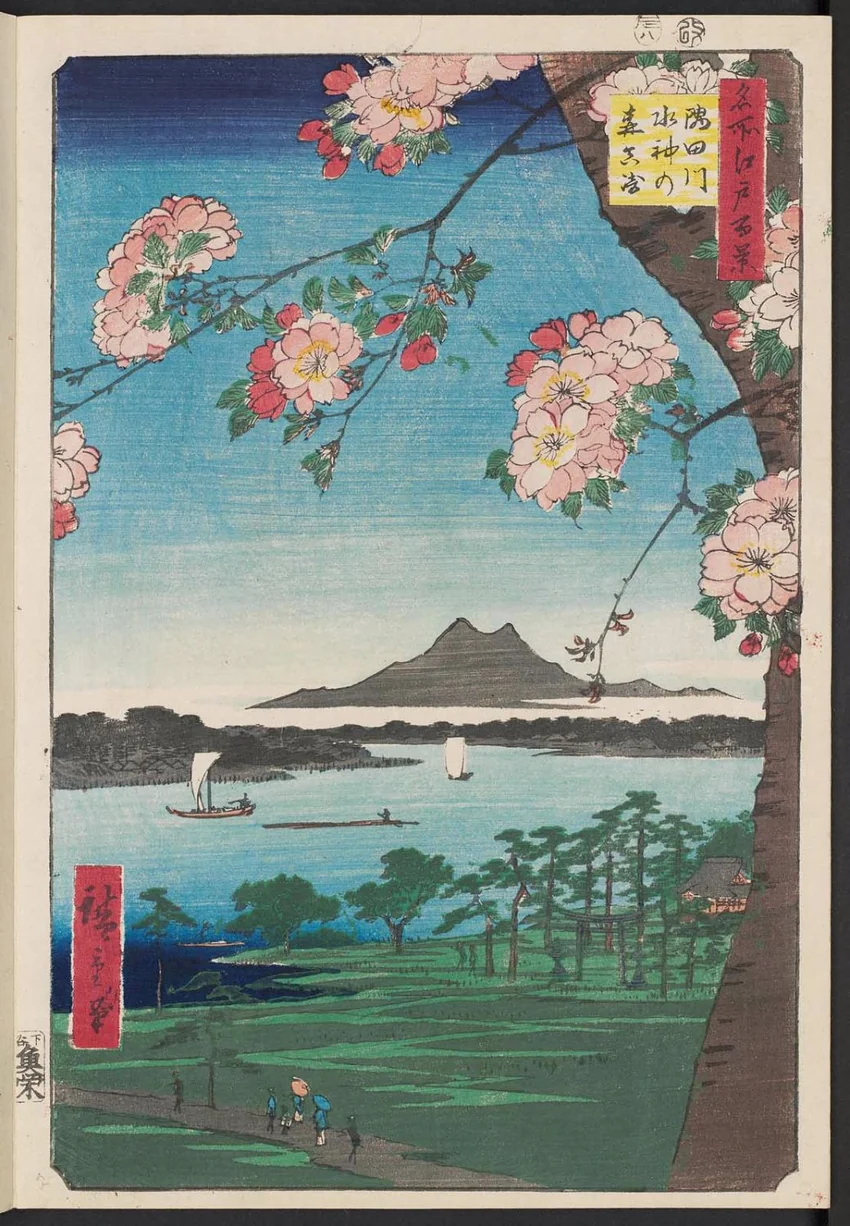
Here I present an engraving of Hiroshigea Japanese landscape painter who had a great influence on the work of Western artists such as Van Gogh, Gauguin, Degas y Monet. A small sample of how we are alike in certain aspects: nature in its various shades has always inspired artists of all times and places.
When it is said that someone is in the ' flower of life' refers to your youth, to when you are at your best, beautiful and full of energy.
The same is true for spring, is used as an allegory for adolescence. There are occasions when it is associated spring to childhood and summer to puberty.
Also spring is linked to renewal, to the beginning of a new cycle.. This is because spring is considered the first season of the year and winter, the last one. This cold and dark season by its characteristics is related to the end of the cycle, old age or death.
From the reasoning that spring is the first season and marks a new cycle, comes the expression: how many springs do you have? which we use to count the years and to mark the passage of time.
A popular saying goes that 'spring changes the blood'. At this time of the year temperatures rise, the flora is full of colors with the germination and flowering of plants and much of the fauna is predisposed to courtship and mating, including humans. Hence also spring is linked to increased sexual desire, fertility and abundance.

"I want to do with you what spring does with the cherry trees."
Pablo Neruda
Whether in literature, art or verbal expressions, the relationship of spring with all the attributes mentioned above is clear. Y in Japan, the main icon of this season is the cherry blossom.. This makes the sakura is directly linked to the symbolism of spring.
In the flower of life
Taking advantage once again of the expression 'in the flower of lifeI would like to make a small parenthesis here to speak about the bijin-ga and its relation to the sakura.
Bijin-ga is a term used to refer to illustrations of beautiful women of the genus Ukiyo-e.
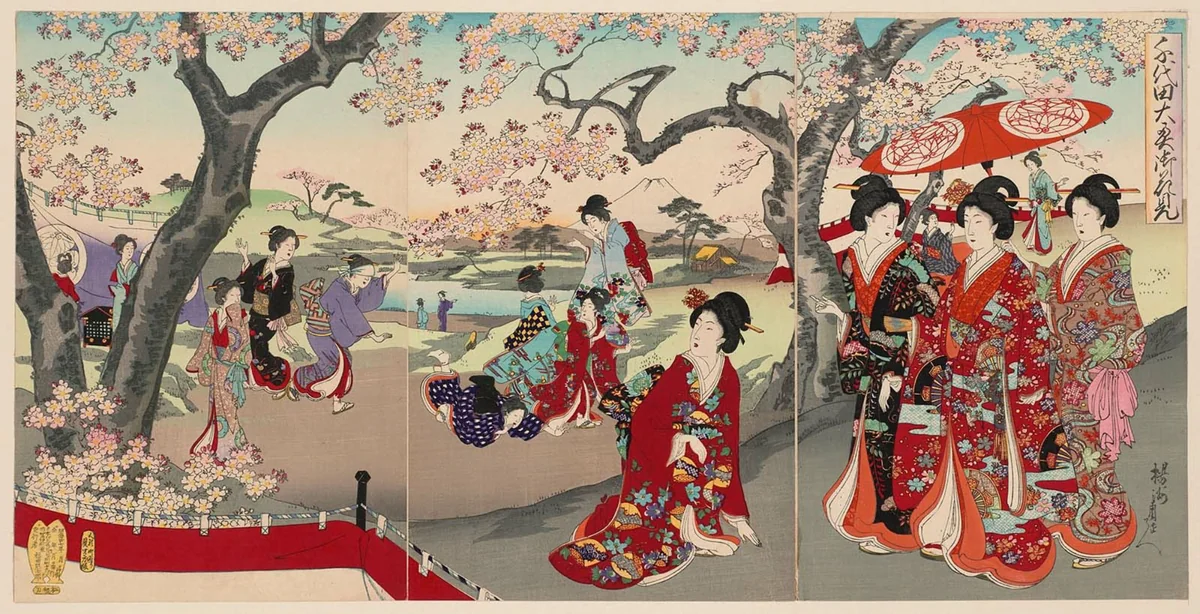
In illustrations bijin-ga as this one of ChikanobuIt is common to see how the author of the work chooses to combine the ideal of feminine beauty with cherry blossoms. A beautiful evoking the model of youth and ephemeral beauty, reinforced by the spring weather..
This formula continues to be used in the most diverse formats of visual representations to this day.
Spring alters the blood
Once again recalling the saying 'spring alters the blood', I would like to comment briefly on the style of stamps shungaa well-known sub-genre of the Ukiyo-e that portrays erotic images.
The word shunga means 'spring images'. In this case 'spring' is a euphemism used to refer to sexual intercourse.
It is to be expected that in a Japanese category of prints bearing the word spring in its name, cherry blossoms would be depicted, and of course they are. Many times it is the sakura emphasizing the representation of sexual actsas seen in this engraving of Eizan.
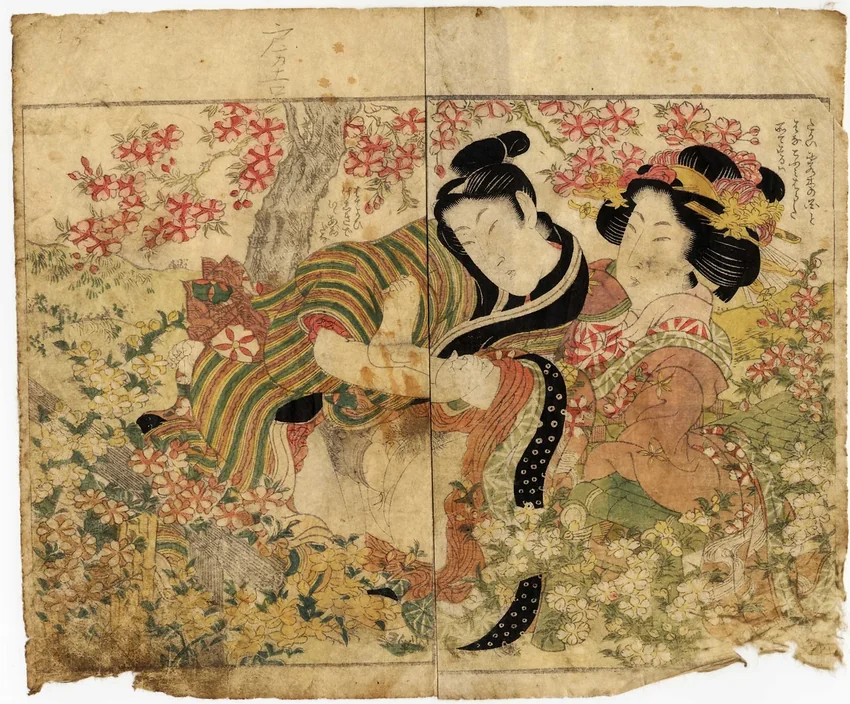
The images of shunga appear in the horimonoThe most common lesions are small and not very visible parts of the body, such as the inside of the arm near the armpit or the inside of the thigh near the groin.
Like almost everything seen in traditional Japanese tattooing, the cherry blossom has its special symbolism and classic forms of representation. This is how everything in the design is defined: the way of drawing the sakuraThe colors that should be used, with which other elements to combine it with or not, etc.
Everything mentioned in the previous paragraph are essential details to achieve the values and aesthetics of the horimonowhen it is what you are looking for.
Many of the things you need to know are already described in this post. But there is much more and if you want, ask me, whether you are my client or not. I will try to answer you privately and spend time to expand this article.
You can see here some pictures of tattoos that I have done with sakura.
You may find more detailed material in the Tattoo Gallery of the web. There I usually upload several photos to better show the details of each tattoo and also tell something more about the work in question.


Here you will find cherry blossom designs made by me. In them I try, in my own way, to capture the traditional aesthetics of the cherry blossom. sakura.
They are drawings designed for tattooing, some of them already tattooed and others available. You can see more like these in the section Drawings of the web, where I also present other characters of Japanese iconography.
You can access here to my dashboard "Sakura - Japanese Tattoo Icon" from my Pinterest account.

The pins you will find are a selection of illustrations and tattoos from various artists, all quite representative in what it comes to represent the cherry blossom.
I have created it to be able to easily access these images and use them as a reference when drawing or tattooing.
They are also useful to show my customers and other interested parties who want to see a small selection of interesting references from sakura.
To know the classical representations of this flower, so important in the irezumi can help when it comes to concretize the idea of a possible tattoo or drawing.
About this article
There is much more to tell about the sakura. This post is open for updates.
I am the author of this writing. I will be delighted if you disclose the text as long as you cite the source and authorship of the text.
The sources of information used for the creation of this text correspond to the following cited documents.
- Tajima, Kazuhiko (2023): EDO FLOWERS Illustrated Encyclopedia of Japanese Flowers. Gijón, Satori Ediciones.
- Rubio, Carlos (Second edition 2022): LOS MITOS DE JAPÓN. Madrid, Alianza Editorial.
- Ibarzabal, R. (Second edition 2021): CHRONICLES OF THE SAMURAI. Gijón, Satori Ediciones.
- Oguri, Kazuo (2002): GIFU HORIHIDE Tattoo Illustrations and Photography Vol.2. Tokyo, Keibunsha Co. Ltd.
https://es.wikipedia.org/wiki/Sakura_(cerezo)