Talk to me through whatsapp!


I drew "Saint George the Holy Warrior". inspired by an old painting of St. George and the dragon of my grandmother, I did it in honor of the saint and the great Brazilian musician Jorge Ben Jor. I dedicate it to the Jorges in my life and to all those who identify with the music "Jorge da Capadócia" that appears in video format in this article.
Those who know me know that I am not a religious person, but I do great admirer and eternal student of iconography of all times and places. Definitely, there are images and imagery that have a lot of power and bring within themselves many teachings, unquestionable for those who wish to look for them and totally invisible to others.
As a Brazilian, I could not help but notice St. George. And I don't need to tell Brazilians how strong this saint is in our country. He is undoubtedly one of the most popular saints in Brazil..

The warrior saint is present in the form of large and small illustrations or statues in houses, workplaces and cars. You can find him both in churches and terreiros as in the bars of Brazil.
People wear medals with the image of St. George, or guides in honor of Ogún. It is also very common to see people with t-shirts, caps, badges and all kinds of accessories to have this beloved saint always near, and thus protect them and open their paths.
I have lost count of the tattoos of St. George that I have done when I lived there. Always the same representation, the best known of all: the saint with his spear riding the white horse at the very moment they face the dragon.
Normally customers ask for a small, symbolic tattooas if it were a a lifelong amulet that will never break or be lost.. For my part, I think that, because of the details of the composition and everything it represents, it is an ideal motif for a large tattoo that takes up the entire back, arm or thigh.
In addition to all these religious devotees that St. George has in Brazil, there are those who, like me, simply feel a great sympathy for this saint.
I think one of the reasons is that wherever you go, you can see some representation of him, he lives in people's hearts, but he is also physically there, in Brazil it is difficult to spend a day without seeing him there.
I also think that The prayers to St. George are quite special, both the Christian and the candomblé. They are beautiful words evoking the deeds of courage of a man who lived many centuries ago, praying that he may guide and protect them in their ways. These prayers inspire people, even if they are not religious practitioners..
Jorge Ben Jor launched "Jorge da Capadócia" in 1975.and this song is still playing as loud as ever. The music bears this name because the saint was a Roman soldier born in this magical place of lunar landscapes, which now belongs to Turkey.
Several times this song was re-recorded, covered and performed by other musicians.Just like the image of St. George, which has been reproduced by countless artists and craftsmen over time.
I cannot fail to mention here the versions of Fernanda Abreu (1992), by the rap group Rational MC's (1997) and that of Caetano Veloso. The melody of each one of them is totally different and you can tell that everyone has put their heart into putting this prayer to music. All three versions are very good and all of them have been very successful in Brazil.
Here is the Spanish translation of the lyrics of the song:
George of Cappadocia - music by George Ben Jor
Jorge asked for a place in the cavalry
I am happy because I am also from your company
I am dressed in Jorge's clothes and weapons.
So that my enemies may have feet, so that they do not overtake me
So that my enemies have hands, do not grab me, do not touch me.
So that my enemies may have eyes and not see me
Not even a thought they may have to do me wrong
Firearms will not reach my body
Knives, spears to break, without my body touch
Ropes, chains burst, without my body to tie up
Well, I am dressed with Jorge's clothes and weapons.
Jorge is from Cappadocia, long live Jorge!
Jorge is from Cappadocia, hail Jorge!
Perseverance, won out over sordid pretence
And from this all love was born
Perseverance, won out over sordid pretence
And from this all love was born
Ogan plays for Ogún
Ogan plays for Ogún
Ogan Ogan plays for Ogún
Jorge is from Cappadocia
Jorge is from Cappadocia
Jorge is from Cappadocia
Jorge is from Cappadocia
Ogan plays for Ogún
Ogan plays for Ogún
Jorge has enlisted in the cavalry.
And I am happy because I also belong to your company.
Ogan plays for Ogún
Ogan plays for Ogún
George of Cappadocia (several times)
If you do a little research, you will find that this saint has devotees all over the world. People of different races and religionsThis is something I love about St. George.

Syncretism is not only found in African-American religions, but also among Muslims, especially in Palestine.
Countless localities, churches and temples are named after St. George all over the world, and his symbolism was used in many flags and shields. Several military orders bear his name, and he is the patron saint of several cities and countries around the world, including Georgia, Portugal and England, among others.
Many countries dedicate one day of the year to honor their saints. In the case of St. George, this date may vary from place to place.
In the West, the saint's day is April 23.. This was the day on which, in 303 by order of the Roman Emperor Diocletian, George of Cappadocia was beheaded for not denying his Christian faith.
Why are so many of us fascinated by St. George?Have you noticed that the story of the painting in question is similar to many others? Doesn't this sound familiar to you, having to face some monster and rescue someone in danger?
In the ninth century the first written record of the story of "St. George and the dragon" appears. as part of The Golden LegendSt. George and his horse defeat the dragon and save the princess. It is likely that this story has given rise to all of the stories about princesses and dragons in West.
There are many similar accounts in other cultures, earlier and later. I will not go into details of dates or question whether someone copied someone else. I lack the knowledge to do so and it does not seem relevant to me.
New versions of old stories, or new stories with old elements and situations, are very common. And many times it seems to us that even in real life the same stories repeat themselves.
To speak of some similarities, do you remember the Greek myth of Perseus, the young woman Andromeda and the sea monster? And if you are a fan of Japanese culture, as I am, do you know the history of the god Susanoo in its battle with the snake eight-headed Yamata no Orochi to save the maiden Kushinada?

I have cited just two examples of similarities with the story of St. George and the dragon, but surely you have remembered a few more.
St. George in this myth represents seamlessly a well-known archetype: that of the heroin their eternal struggle of Good against Evil. For those who wish to know more about the archetype of the hero, I recommend Carl Gustav Jung and Joseph Campbel.who have developed this topic quite a bit.
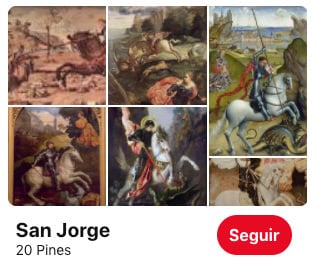
I've created a board on my Pinterest account with some classic renderings for those who want to see them. In all the illustrations I have chosen St. George and the dragon. There are other representations of other scenes with this saint, but the moment when George of Cappadocia faces the dragon is by far the most representative and symbolic of this character..
I end this article with my favorite representation of St. George. It is entitled St. George and the dragon fightby the painter Peter Paul Rubens made between 1606 and 1607.
Four centuries after it was painted, I have seen this painting live for the first time. In 2006, when I was at the Prado Museum in Madrid, just after arriving in Spain, also for the first time. I had been analyzing this work in my Fine Arts degree in Porto Alegre - Brazil a few years before. In those days I did not know that I would get to see it and for me it was quite an experience.

This painting is 309x257cm and it has nothing to do with being able to appreciate it live with seeing it through a screen or in a book.
Since then, I have seen this work a few times and I can't get enough of it. I recommend you to visit the Prado Museum, not once but several times, to see it little by little and thus be able to "taste with your eyes" everything that is there, and do not forget to visit the St. George by Rubens!
There is much more to tell about St. George. This post is open to updates. It is possible that I will add more information. If you want, you can participate by leaving your comment!
I am the author of this article. I will be delighted if you disclose this text as long as you cite the source and authorship.
The sources of information used for the creation of this text correspond to the following books and pages cited.
SHUKER, Karl (2006): Dragons - an illustrated history. Netherlands, Evergreen Editions.
Wikipedia - George of Cappadocia

If you want to see my complete drawing of "St. George the warrior saint" with annotated description, click here!